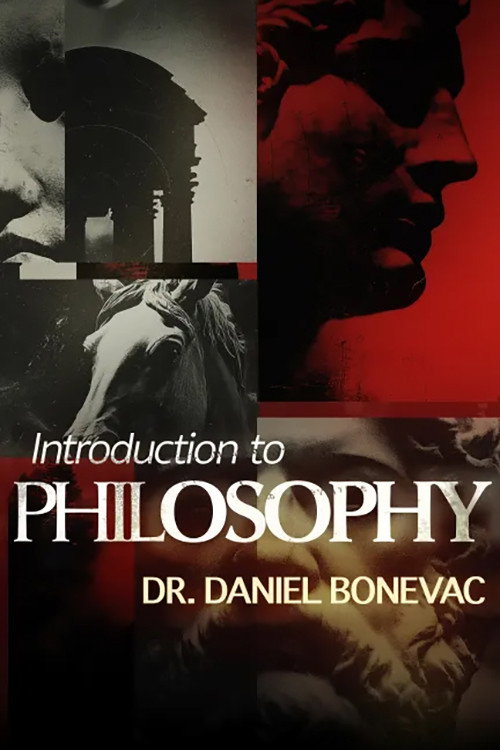
Introduction to Philosophy (2026)
In Introduction to Philosophy, a nine-hour course, Dr. Bonevac guides us through the major traditions of Western philosophy in eight engaging lectures on ethics, metaphysics, and epistemology. We explore three key ethical frameworks—virtue ethics, deontology, and consequentialism—before tackling fundamental questions about reality, from realism to idealism. The course then examines theories of knowledge, weighing skepticism’s doubt, rationalism’s innate ideas, and empiricism’s reliance on experience. Finally, we consider how these philosophical traditions continue to shape debates about morality, reality, and human understanding today.
Watch now
Episodes
- 1 1. On Virtue2026-01-16 · 1h 1mIn our introductory lecture, Dr. Bonevac explores the foundations of ethics through virtue theory, drawing on Confucius, Socrates, Plato, and Aristotle to examine what it means to
- 2 2. On Deontology2026-01-16 · 1h 15mIn lecture two, we turn to deontological ethics, which emphasizes moral principles and rules for action rather than character traits. We consider a range of approaches—from Abelard
- 3 3. On Consequentialism2026-01-16 · 1h 6mIn lecture three, we explore consequentialist ethics, focusing on utilitarianism as developed by Jeremy Bentham and John Stuart Mill. We examine how actions are judged by their out
- 4 4. On Realism2026-01-16 · 1h 5mIn lecture four, we learn about realism in Western philosophy through the contrasting views of Plato and Aristotle. We examine Plato’s theory of Forms, where abstract universals li
- 5 5. On Skepticism2026-01-16 · 1h 3mIn lecture five, we encounter the philosophical tradition of skepticism, examining arguments that challenge our ability to know anything or have reasonable beliefs, from ancient Gr
- 6 6. On Rationalism2026-01-16 · 1h 0mIn lecture six, we investigate the rationalist tradition, tracing its roots from Plato to modern thinkers like Descartes and Leibniz. We focus on how rationalists respond to skepti
- 7 7. On Empiricism2026-01-16 · 1h 7mIn lecture seven, we study empiricism through John Locke and David Hume, who follow Aristotle in arguing that all knowledge comes from experience rather than innate ideas. We trace
- 8 8. On Idealism2026-01-16 · 1h 15mIn lecture eight, Dr. Bonevac delves into idealism, the philosophical view that everything is mind-dependent, contrasting it with realism which holds that some things exist indepen
Cast
 Dr. Daniel BonevacHost
Images
You might also like
 ★ 6.8
 ★ 8.4
 ★ 7.6
 ★ 7.5
 ★ 6.5
 ★ 8.0
 ★ 8.3
 ★ 7.6
 ★ 7.1
 ★ 7.5
 ★ 8.0
 ★ 7.8
 ★ 6.4
 ★ 7.5
 ★ 7.0
 ★ 8.2
 ★ 7.6
 ★ 6.7