Trials of Life S01E02 · Growing Up
Watch now
Overview
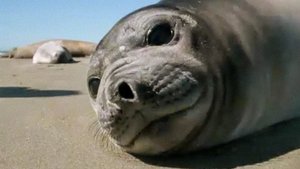
This programme describes the ways that various species care for their young. Attenborough defines childhood as achieving two tasks: growing and surviving. He highlights the elephant seal as an animal that experiences a compressed childhood, being abandoned after three weeks and left for up to another eight alone, while it becomes large enough to be able to swim. For terns, there is safety in numbers as the dense population works together to drive out marauding gulls. The snow geese in the Russian arctic show intense devotion as they escort their goslings by foot to the coast some 50 kilometres away. Scorpions carry their young on their backs, while a shrew will leave hers under a stone while she goes to feed. The eider duck is one creature that shares responsibility for its offspring: females regularly supervise the ducklings of others in a group. The mara is another that uses a crèche system, as does the bat, whose nurseries can be up to a million strong. The Florida scrub jay has developed complex parental relationships, using teams rather than pairs. Such behaviour is exhibited on a larger scale by elephants, where all females take an interest in raising a single calf. A chimpanzee’s childhood is socially complicated, as an individual must learn how to behave towards others, as well as master the use of tools. Albatrosses must be accomplished fliers as soon as possible - chicks are shown being hunted by tiger sharks.
Torrents
Searching torrents…
Subtitles
…
Episodes
-
 1
1. Arriving1990-10-04 · 50mThe first episode examines the various methods by which creatures come into the world. Attenborough’s opening statement alludes to the annual spawning of the Christmas Island red c
1
1. Arriving1990-10-04 · 50mThe first episode examines the various methods by which creatures come into the world. Attenborough’s opening statement alludes to the annual spawning of the Christmas Island red c
-
 2
2. Growing Up1990-10-11 · 50mThis programme describes the ways that various species care for their young. Attenborough defines childhood as achieving two tasks: growing and surviving. He highlights the elephan
2
2. Growing Up1990-10-11 · 50mThis programme describes the ways that various species care for their young. Attenborough defines childhood as achieving two tasks: growing and surviving. He highlights the elephan
-
 3
3. Finding Food1990-10-18 · 50mThe next installment is devoted to the ways in which animals gather their sustenance. Attenborough begins in the South American rainforest, where the proliferation of animal and pl
3
3. Finding Food1990-10-18 · 50mThe next installment is devoted to the ways in which animals gather their sustenance. Attenborough begins in the South American rainforest, where the proliferation of animal and pl
-
 4
4. Hunting and Escaping1990-10-25 · 50mThis episode looks at those that hunt other creatures and ways of avoiding capture. Attenborough is attacked by a pair of skuas as he approaches their nest, which demonstrates this
4
4. Hunting and Escaping1990-10-25 · 50mThis episode looks at those that hunt other creatures and ways of avoiding capture. Attenborough is attacked by a pair of skuas as he approaches their nest, which demonstrates this
-
 5
5. Finding the Way1990-11-01 · 50mThis programme explores forms of navigation. Attenborough starts in Africa at dusk, by describing some of the species that don't rely on sight. The spotted hyena uses its acute sen
5
5. Finding the Way1990-11-01 · 50mThis programme explores forms of navigation. Attenborough starts in Africa at dusk, by describing some of the species that don't rely on sight. The spotted hyena uses its acute sen
-
 6
6. Home Making1990-11-08 · 50mThis installment deals with how animals construct their shelters from the elements and predators. Burrows and holes can provide considerable refuge, and Attenborough inspects the h
6
6. Home Making1990-11-08 · 50mThis installment deals with how animals construct their shelters from the elements and predators. Burrows and holes can provide considerable refuge, and Attenborough inspects the h
-
 7
7. Living Together1990-11-15 · 50mThis episode focuses on those species that co-operate and depend on (or exploit) others. Spotted deer follow langur monkeys as they travel from tree to tree, eating any leaves that
7
7. Living Together1990-11-15 · 50mThis episode focuses on those species that co-operate and depend on (or exploit) others. Spotted deer follow langur monkeys as they travel from tree to tree, eating any leaves that
-
 8
8. Fighting1990-11-22 · 50mThis programme details how fighting - both physical and psychological - is used for food, land or to gain a mate. Territorial conflict is demonstrated by the hummingbird, and Atten
8
8. Fighting1990-11-22 · 50mThis programme details how fighting - both physical and psychological - is used for food, land or to gain a mate. Territorial conflict is demonstrated by the hummingbird, and Atten
-
 9
9. Friends and Rivals1990-11-29 · 50mThis installment investigates the ways in which those animals that live in social groups interact with each other. The solitary eagle is contrasted with whooper swans landing in Sc
9
9. Friends and Rivals1990-11-29 · 50mThis installment investigates the ways in which those animals that live in social groups interact with each other. The solitary eagle is contrasted with whooper swans landing in Sc
-
 10
10. Talking to Strangers1990-12-06 · 50mThis episode concentrates on communication. In Kenya, Attenborough accompanies a tribesman who calls to a honeyguide, which in turn answers him and leads the pair to a bees' nest.
10
10. Talking to Strangers1990-12-06 · 50mThis episode concentrates on communication. In Kenya, Attenborough accompanies a tribesman who calls to a honeyguide, which in turn answers him and leads the pair to a bees' nest.
-
 11
11. Courting1990-12-13 · 50mThis programme surveys the methods employed in attracting a mate, mainly those of birds. The Indian florican inhabits long grass, and so is difficult to see. In order to gain atten
11
11. Courting1990-12-13 · 50mThis programme surveys the methods employed in attracting a mate, mainly those of birds. The Indian florican inhabits long grass, and so is difficult to see. In order to gain atten
-
 12
12. Continuing the Line1990-12-20 · 50mThe final installment illustrates how species fulfill their ultimate raison d'être and ensure that their genes are passed on to the next generation. It is a universal problem, but
12
12. Continuing the Line1990-12-20 · 50mThe final installment illustrates how species fulfill their ultimate raison d'être and ensure that their genes are passed on to the next generation. It is a universal problem, but